My English Brain Dump Podcast - Episode One
January 2026
An Introduction
Welcome to My English Brain Dump, my new podcast and a slightly different kind of English listening practice.
In this podcast, I speak openly and unscripted, sharing thoughts as they come rather than following a lesson plan or a script. It’s the kind of English you hear in real life: natural, informal, sometimes messy, and very human.
If you’re learning English, this podcast is designed to help you get used to how British English really sounds when people think out loud, change direction mid-sentence, or search for the right words. You don’t need to understand everything. The aim is exposure, confidence, and familiarity.
In this first episode, I’m doing a bit of a brain dump, reflecting on the end of 2025, looking ahead to 2026, and sharing a little about my life, my work, and what’s been on my mind. I speak in the same way I would speak to friends or family, which means:
natural rhythm and pace
everyday expressions
hesitation, self-correction, and informal language
real spoken British English, not “textbook” English
You can listen to the episode below, and if you’d like extra support, you’ll find the full transcript underneath so you can read along or download it as a PDF.
How to use this episode for English listening practice
You can use this video in a few different ways:
Listen once for general understanding
Listen again and note down expressions you don’t recognise
Read the transcript and highlight new language
Listen again while following the transcript
Practise shadowing (listening and repeating short sections out loud)
📄 Full Transcript
Full Transcript
A Different Kind of English Listening Practice – Episode 1
Hello, I’m Jo, and today’s video is a little bit different from my usual English learning content.
Today’s video is what you might call a bit of a brain dump. Now, I’ll explain what a brain dump is in a minute, but first of all, what is the purpose of this video? What will you gain from watching this video?
Well, I want to provide you with some English listening practice. Hopefully, this video will give you a perfect opportunity to practise listening to natural, unscripted British English speech. I’m going to talk to you like I talk to my friends and my family, and it might be a little bit tricky.
There might be expressions that you don’t recognise, but I’ll try and explain them along the way. And I’ll also provide a full transcript where you can go through and identify some of the expressions that you don’t understand.
This video is episode one of what I’m going to call Jo’s English Brain Dump Podcast.
So, what is a brain dump?
A brain dump is an informal way of saying that you’re going to get all your thoughts out of your head at once without worrying about order or structure or perfection. It means speaking freely, sharing ideas as they pop into my head, not editing myself too much, not following a script, and letting my thoughts spill out naturally.
People often use the expression “to have a brain dump” when they feel that they’ve got lots of stuff in their head and they want to clear a bit of mental space.
So basically, what we’re talking about here is me wittering on, thinking out loud, and sharing where my head’s at as we come to the end of 2025 and move into 2026.
But before I go any further, first of all, I’d just like to say a very big thank you to anybody who’s watched my videos in 2025.
I’m still a tiny channel, but it’s been really exciting working on my videos and seeing things gradually grow and getting to know you guys a little bit too.
So, like I said, this video is different from my others in that it’s completely unscripted.
I’m winging it.
What does it mean to wing it? Well, it means to do something without much preparation. When you wing it, you improvise and you sort of trust yourself as you go along. You don’t plan it in detail.
So, I’ve got a rough idea about what I’m going to talk about today, but I haven’t made a solid plan. Winging it can be a little bit risky, but let’s have a go anyway.
So first of all, I’d like to introduce myself, because I don’t think I’ve shared very much personal information about myself on my channel.
I’m Jo, and I’m 54. I live just outside London in a little house with my two kids and my dog and my cat.
My kids aren’t really kids anymore. My daughter is just about to turn 18 and my son is 20, so really they’re adults. My son is at university.
He’s at home at the moment because it’s the Christmas holidays, but he’s away for at least half of the year, and my daughter is currently applying to university.
So in September, I will be what we call an empty nester. An empty nester is a parent whose little birds have flown the nest, who have moved away.
Now, I think the chances are that when they both graduate, they’ll be back home, because in England at the moment the price of renting accommodation for young people is incredibly high, and most graduates usually end up going back home to live with their parents.
So I won’t be a complete empty nester. My little birds, my kids, will come back home when they need their washing done, when they need food, when they need money, when they need a roof over their heads.
Meet Gizmo. This is my cat that I mentioned earlier, who’s just decided to join us.
Anyway, giving you a little bit of background on me. Many, many moons ago, which means many years ago, I studied Spanish and Catalan at university. And back then, I did a little bit of English teaching.
But then somehow I fell into mental health work, which I absolutely loved, and it’s something that I still feel quite passionate about. In fact, I would like to maybe talk about mental health in one of these podcasts. If that’s the kind of thing you might be interested in, let me know in the comments.
Anyway, I worked in mental health, and then fast forward to 2020, the pandemic hit. I think a lot of us had a little bit of a rethink about our lives, and it was at this point that I decided to explore different opportunities.
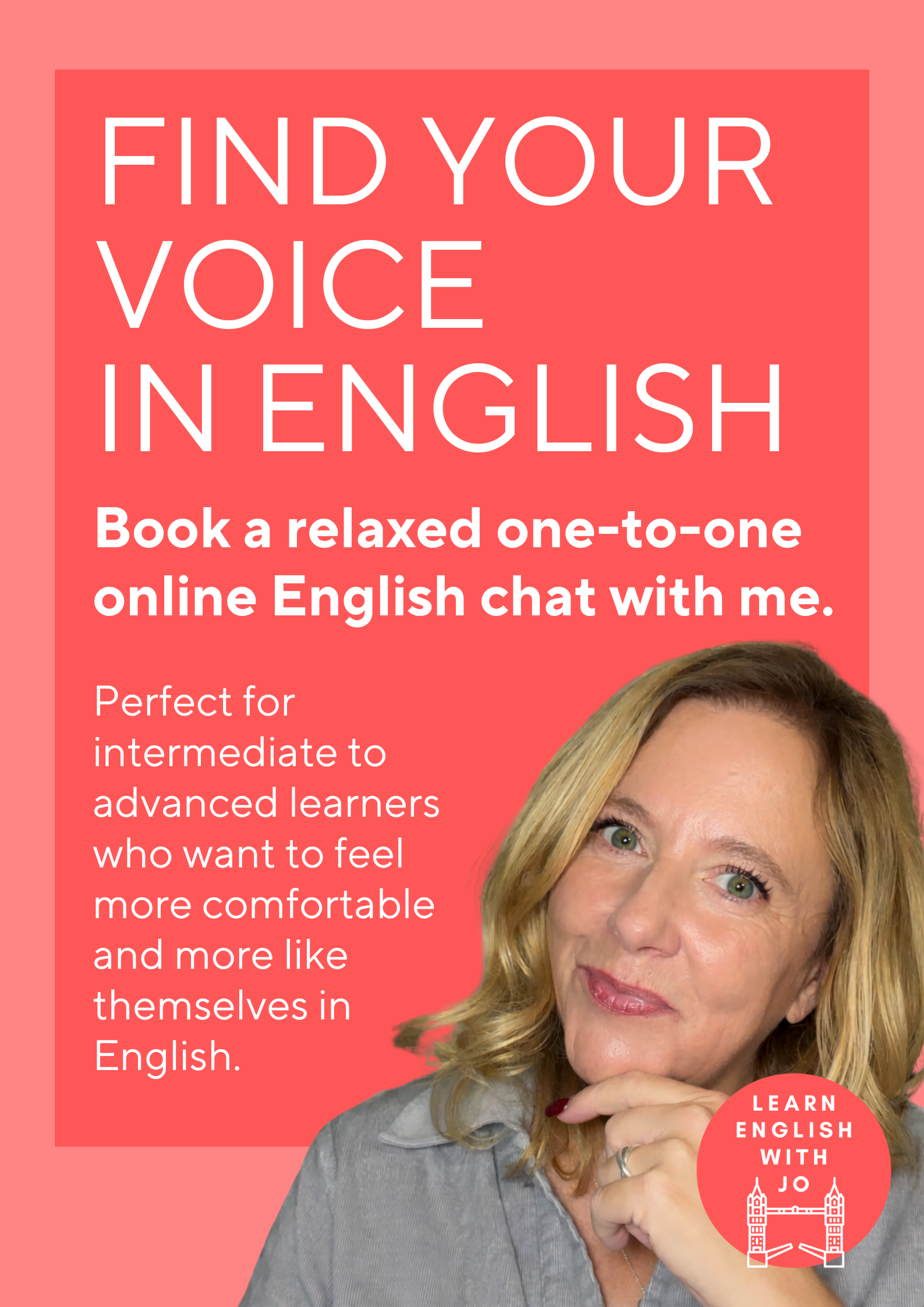
I decided to get into working with English students on a platform called italki. Now, I still do a bit of work on italki, but I’m also opening up bookings on my website, so you can book private conversation classes with me if that’s something you’re interested in.
So I’ve been doing this for six years now, and it’s something that’s evolved and that I absolutely love. I work with people who are intermediate to advanced speakers of English, and in the sessions we really work on conversation skills, on building connection, sometimes exploring cultural differences between English speakers, specifically British English speakers, and other nationalities.
We look at building confidence, and we have really good conversations.
My students come from all walks of life. Some are professionals, some are creatives, some are students and academics, and we talk about things that are important to them.
I feel incredibly fortunate to be doing the job that I’m doing now, because I get to meet really fascinating, interesting people from all over the world from the comfort of my own home, and to learn about their lives and to help them on their English journey.
I try to help them recognise their strengths and to provide a safe place, a safe non-judgemental place, where they can practise their English and play around with their English.
And I guess what a lot of my learners are doing is trying to find their voice in English, so they can express themselves and express their true personality in English, which is difficult in a second language.
So obviously, as well as doing that, I also have a YouTube channel, I have my website, and I also have an Instagram where I post lots of English learning content.
And in 2026, I’m planning on continuing with the one-to-one sessions with learners, but I’m also planning on doing some group sessions on a monthly basis, in a kind of book-club format, looking at self-development books and using them as a springboard for conversation.
These group sessions are going to launch in March, and we’re going to start with the book Atomic Habits. I think Atomic Habits is a book that many of us have encountered one way or another. It’s been translated into many languages, it’s a global bestseller, and I’ve personally benefited from applying some of the ideas to my own life.
I think it can be applied to language learning, to work scenarios, and to family life, so it feels like a good one to start with.
If you’re interested in these group sessions, the best thing to do is nip over to my website and join my mailing list, because that’s where I’ll post updates and news about the launch. You could also send me an email, which I’ll include in the description, or comment below if it’s something you might be into.
So, moving away from that a little bit, I wanted to ask you what your 2025 was like, and what your intentions for 2026 might be, if you have any.
I tend to use the word “intentions” rather than “resolutions”, because I don’t know about you, but I have a notoriously bad reputation when it comes to resolutions. My resolutions usually last about a week.
When I use the word intention, it feels more like a state of mind that spans the whole year, whereas a resolution sounds very absolute and like it has to start immediately. An intention feels longer-lasting and a little less dramatic, a little less severe.
So I just wondered if you have any intentions for 2026, and what they are. I’d really like to hear them in the comments.
For me, 2025 was quite tough from a health point of view. I don’t think I’ve really mentioned it on this channel before, but I have two chronic health conditions.
I have rheumatoid arthritis, and I’m also diagnosed with bipolar disorder, which is a mental illness. The bipolar is very well controlled. I take medication and I have lots of self-management techniques that help me stay well.
Up until recently, the rheumatoid arthritis was also fairly well controlled, but in 2025 I’ve had more flares, more pain, and more fatigue, and it’s quite draining.
I know a lot of people have experience of chronic illness, and it can really affect your mood and bring you down.
So going into 2026, I really want to focus a little bit more on my physical health, looking after myself and building strength. When you get to my age, muscle is incredibly important, and I don’t have much of it.
So 2026 might be about building strength, building muscle, and being more mindful about what I’m putting into my body. My eating habits aren’t the best, and there’s a lot I could do when it comes to nutrition.
Another thing that I feel was a bit of a fail in 2025 is learning Mandarin. I set myself a challenge of working on Mandarin for at least half an hour every day.
Until about June, it was going really well. It was all going swimmingly, and although I was at a very basic level, I felt committed and felt like I was making progress.
Then I’m not quite sure what happened, but everything ground to a halt, and I stopped. Now I feel like I can barely remember a word, and it feels like I’ve lost everything I learned.
So in 2026, I’d like to pick this up again. I’d also like to practise my Spanish more and book a few conversation classes myself.
These are intentions rather than resolutions. I’m not saying I’ll pass an exam by the end of the year. I’m saying I’ll return to half an hour of Mandarin a day, practise my Spanish speaking skills, and practise what I preach.
So do share some of your intentions for 2026 in the comments. I’d love to hear what you’d like to focus on and how you’d like to grow.
In future episodes, I’d like to talk more about mental health, AI, books, being a parent, and lifelong learning, which is incredibly important to me.
If you have any ideas for things you’d like me to talk about in the podcast, do let me know in the comments.
I think we’ll wrap it up there. To be honest, I don’t feel entirely comfortable talking about myself, but I wanted to give it a go and step out of my comfort zone.
That was my first brain dump. Hopefully it wasn’t too chaotic.
Don’t forget you can download the transcript if you find it helpful.
Before I go, I’d like to wish you a very happy, healthy, and peaceful 2026.
I’ll still be making my regular videos alongside these podcast episodes, so if you’re interested, make sure you subscribe. And if you enjoyed today’s video, give it a thumbs up. It really helps.
Take care. Lots of love.