I Understand English but Can’t Speak It: Why You Still Don’t Feel Ready
You can understand English when you read it. You can follow podcasts, films and YouTube videos. You may have studied grammar and vocabulary for years.
But when somebody asks you a question in English, the words seem to disappear.
You pause. You worry about making a mistake. The sentence that comes out of your mouth sounds much simpler than the one you had in your head. Ten minutes later, you think of exactly what you wanted to say.
If you understand English but struggle to speak it confidently, it doesn’t necessarily mean that your English isn’t good enough. You may already have enough English to communicate. What you may not have yet is enough experience of trusting yourself to use it in real time.
That distinction matters because the answer may not be another grammar course or another list of vocabulary. It may be more conversation.
The short answer: Understanding English and speaking English are different skills. Listening and reading allow you to recognise language. Speaking requires you to find and organise that language yourself, while listening, thinking and responding to another person. That ability develops through use.
Prefer to watch or listen? Watch the accompanying video: Why You Still Don’t Feel Ready to Speak English.
Why can you understand English but not speak it?
When you listen to English, much of the language is provided for you. You hear a word or expression and recognise its meaning from the surrounding sentence.
Speaking works differently. You begin with an idea and have to find the language yourself. You must choose vocabulary, organise the grammar and pronounce the words—all while paying attention to the other person and deciding what you want to say next.
Learning a word is one thing. Finding it while somebody is waiting for you to finish your sentence is another.
Understanding a grammar rule in an exercise is one thing. Choosing the right tense while telling a story is something else entirely.
This is why somebody can have a strong knowledge of English but still find spontaneous conversation difficult. It isn’t evidence that all those years of learning have failed. It simply means that knowledge and real-time communication are not quite the same thing.
Is your English already good enough to speak?
“Is my English good enough?” is such a large question that it isn’t always very helpful.
The English you need for a relaxed conversation over coffee is different from the English you might need to give an academic presentation, negotiate a contract or pass a proficiency exam.
There may be situations that you aren’t ready for yet. That doesn’t mean you aren’t ready for any of them.
Instead of making one enormous judgement about your English, consider what it already allows you to do:
Can you understand the main idea of this article?
Can you express an opinion if you have a little time to think?
Can you describe something when you don’t know its exact name?
Can you give an example or explain your meaning in another way?
Can other people usually understand you, despite occasional mistakes or pauses?
If you can do most of those things, you will still have plenty to learn. We all do. But a lack of English knowledge may not be the main reason you avoid speaking.
There is a difference between not having enough English to communicate and not trusting yourself to use the English you have.
When learning English becomes a hiding place
Real conversations are unpredictable. You don’t know what the other person will say, you can’t prepare every answer and you can’t stop the conversation while you search for the perfect expression.
That unpredictability is part of what makes conversation interesting. It is also what makes it feel vulnerable.
So it is completely understandable that many learners remain in the safer world of preparation. You listen to another podcast, revise another grammar point or learn another set of phrasal verbs.
All of those things can be useful. I’m an English teacher, so I’m certainly not going to tell you to stop learning English.
But sometimes learning becomes a way of avoiding the uncomfortable experience of using what you have learnt.
You can spend years preparing to speak English without ever feeling completely prepared to speak it.
Another podcast might teach you ten useful expressions. It cannot give you the experience of forgetting one of them, staying in the conversation and discovering that you can still communicate without it.
A grammar exercise can tell you whether you chose the correct tense. It cannot show you that somebody can understand your story perfectly well even when the tense isn’t quite right.
Sometimes “I need to improve my English” means exactly that. There are gaps in your knowledge that are making communication difficult.
But sometimes it means:
“I don’t feel comfortable letting another person hear the English I have now.”
That isn’t simply a language problem.
Why you don’t feel like yourself when you speak English
Most of the people I work with are intelligent, interesting adults.
In their first language, they can express complicated ideas. They can be funny, precise, spontaneous and subtle. They can tell stories, make quick jokes and choose words that reflect their personality.
Then they speak English and feel like a smaller version of themselves.
They have to simplify what they want to say. They lose a word halfway through an interesting idea. The sentence that comes out of their mouth bears little resemblance to the sentence they had in their head.
This can be incredibly frustrating.
You may not simply be afraid of making a grammatical mistake. You may be afraid that somebody will mistake your level of English for your level of intelligence.
You may worry that you appear quieter, less interesting or less capable than you really are. You may feel that you have less control over how other people see you.
When you say, “My English isn’t good enough,” perhaps part of what you mean is:
“I don’t feel enough like myself when I speak English.”
If that is the real problem, learning another twenty phrasal verbs probably won’t solve it on its own.
More language will help, but you also need experiences showing you that you can contribute, be understood and connect with another person—even when your English doesn’t come out perfectly.
What English fluency actually looks like
During my one-to-one English conversation sessions, somebody will sometimes stop because they can’t remember a particular word.
They apologise and say something such as, “Sorry, my English is terrible today,” or, “I don’t know how to explain it.”
Then they describe the thing. They give me an example. I ask a question or suggest a word, and the conversation continues.
To the learner, the pause may feel like proof that their English has failed.
I often see something completely different.
They didn’t have the exact word, so they found another way to communicate. They stayed in the conversation. They noticed that something wasn’t clear and tried to explain it differently.
That isn’t failed communication. It is a conversational skill.
The pause that felt enormous to them may barely have registered with me. I was interested in the idea they were expressing. I was listening to the person, not assessing their English.
We often imagine a fluent speaker producing complete, beautifully organised sentences without pausing, hesitating, repeating themselves or changing direction halfway through an idea.
But listen carefully to people speaking their first language. We pause, forget words, abandon sentences and try explanations again. Sometimes we ask ourselves aloud, “What’s the word I’m looking for?”
Fluency doesn’t mean that you never get stuck. Part of fluency is knowing what to do when you get stuck.
Useful expressions include:
“I’m not sure what the word is, but it’s something you use for…”
“That’s not quite what I mean. Let me try to explain it another way.”
“Could you give me a moment to think?”
“I’ve forgotten the exact word, but what I mean is…”
Being able to continue without the perfect word may be more useful than knowing the perfect word.
How to become more confident speaking English
You don’t need to become completely confident before you begin speaking. Speaking is part of how you become more confident.
A successful conversation doesn’t have to mean that you spoke perfectly. It might mean that:
You said something when you would previously have remained silent.
You expressed an opinion without being able to explain every detail.
You admitted that you hadn’t understood instead of pretending that you had.
You forgot a word and found another way to continue.
You discovered that the conversation survived a mistake.
Every experience gives you a small piece of evidence: you can cope with a pause; you can clarify your meaning; and you don’t need to control every word to communicate successfully.
Confidence rarely arrives first and gives you permission to speak. More often, confidence grows because you spoke and discovered that you could manage what happened.
Your imperfect English still matters in the age of AI
Artificial intelligence can produce extremely polished English in seconds. It can correct grammar, reorganise sentences and replace ordinary vocabulary with more sophisticated words.
That can be very useful. I use AI myself.
But if the purpose of language were simply to produce flawless sentences, a machine could already do that more quickly than either you or I can.
We don’t have conversations simply to exchange perfect sentences. We use language to be curious, disagree, tell stories, make somebody laugh, offer comfort and explain things that matter to us.
AI can improve your sentence. It cannot replace your reason for saying it.
It cannot replace your experiences, your curiosity or your particular way of seeing the world. Those are the things that make you worth talking to—not whether you remembered to use the present perfect.
Accuracy still matters. If a mistake prevents somebody from understanding you, learning to express the idea more clearly will help. If you need English for a particular job or qualification, you may have specific language to work on.
But a conversation is not a competition in which the person who makes the fewest mistakes wins.
Your pauses and occasional mistakes do not make your ideas less valuable.
Start using the English you have now
Your English does not need to be finished before you use it.
Instead of judging your entire level, ask yourself:
“What would I like to be able to do in English?”
Then find one small opportunity to begin doing it with the English you have now.
That could mean asking one question in a meeting instead of staying silent. It could mean sending a voice message rather than carefully writing everything down. It could mean joining a conversation, even if you listen more than you speak at first.
Or it could mean having a one-to-one conversation somewhere you are allowed to pause, make mistakes, ask questions and try again.
Book a one-to-one English conversation
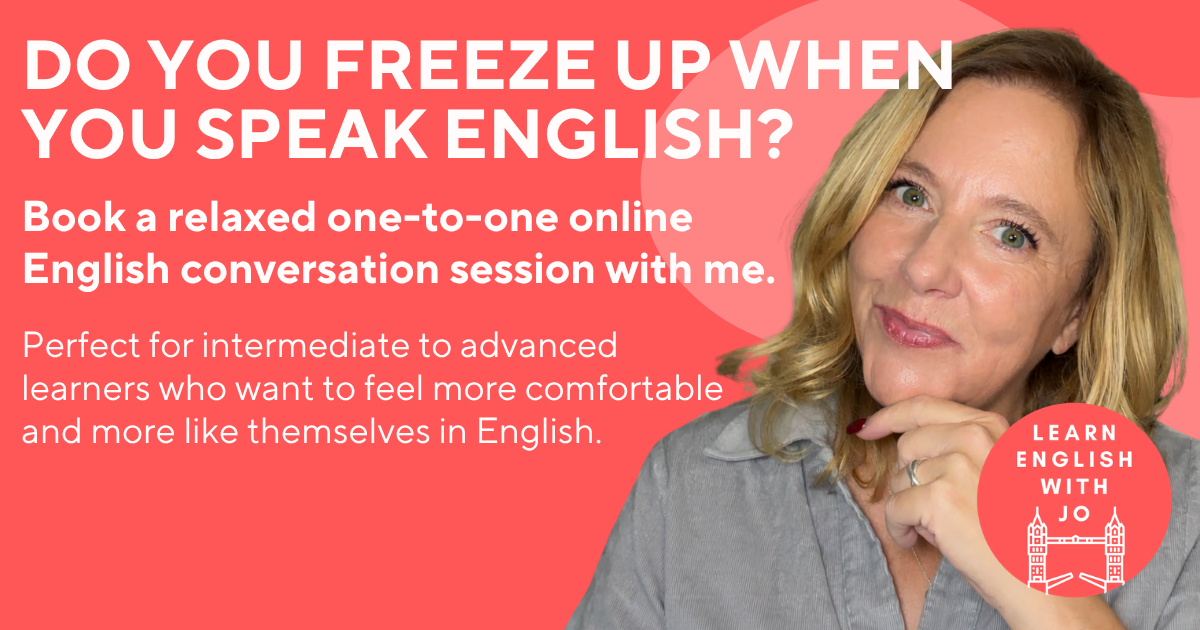
My online conversation sessions are for intermediate and advanced adults who understand a lot of English but find it harder to access that English in real time or who simply don’t feel quite like themselves when they speak.
They aren’t tests. We have a genuine conversation about subjects that interest you. I give you time to think and express your ideas, help when you need it, and send you useful written language notes afterwards.
You don’t need to become confident before you book. The conversation is somewhere you can begin building that confidence.