
Five tips for using Claude prompts to improve your English speaking practice
In my last blog I looked at How to use AI to practise speaking English, with a focus on Anthropic's Claude.
So if you have already given it a try, that’s great. But there is a difference between having a conversation with an AI and actually making progress. A lot of it comes down to how you set the session up.
So today I've got a handful of tips to help you get more out of your conversations with Claude.

Be specific with your Claude prompts
‘Let's chat’ gives Claude almost nothing to work with.
Tell it what kind of conversation you want. Give it a theme. Mention your level. Ask for a specific type of feedback. The more direction you give, the more useful the session tends to be. Vague prompts produce vague results.
For a selection of well-constructed prompts, have a look at my PDF 20 Speaking Prompts to Practise English With Claude
Choose topics you actually care about
Textbook topics are fine, but they rarely produce your best language.
The richest conversations tend to happen when the subject means something to you. A decision you are trying to make. A book you have just finished. Something at work that has been on your mind. A news story that made you think. Your real opinions produce better, more natural language than "describe your ideal holiday" ever will.
Focus on fluency before accuracy
This is where a lot of learners quietly self-sabotage.
They stop mid-sentence to correct a mistake, lose the thread, and then feel worse about the whole thing. Try not to do that. Keep going. Let the sentence come out a bit messily if it needs to. You can do the analysis afterwards.
Fluency and confidence tend to grow when you give yourself permission to be imperfect first.
Keep it short and keep it regular
We all have busy lives, so make a sustainable habit. You don’t need an hour. Ten minutes is enough.
Ten minutes done consistently is usually far more valuable than one big session once a week. A short daily habit will make a long lasting difference. If it feels manageable, you are far more likely to do it.
Treat feedback as guidance, Claude makes mistakes too!
Claude can be very useful. It is not infallible.
Sometimes the suggestions will be excellent. Sometimes they will be slightly off, too formal, or not quite how a person would naturally say it. That is fine. Use the feedback as something to consider, not an absolute. If a phrase feels odd, check it with a teacher, look it up somewhere reliable, or trust your own instinct.
Your judgement matters too.
20 Speaking Prompts to Practise English With Claude
If you want to put these tips into practice straight away, I have put together a PDF of twenty Claude prompts designed specifically for English speaking practice. They are grouped by theme, ready to copy and paste, and written to get you into a real conversation quickly.
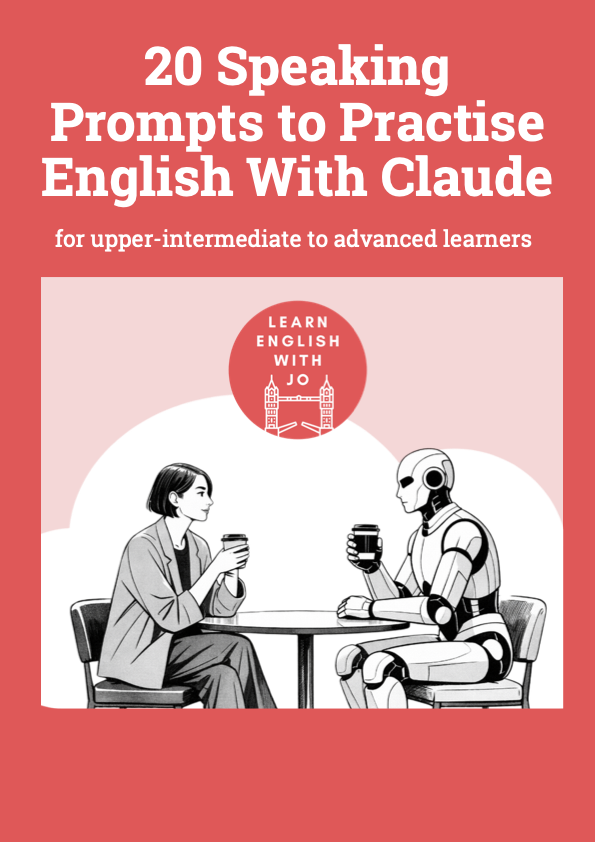
A practical PDF for upper-intermediate to advanced learners who want more speaking practice without the pressure of a formal setting. These 20 prompts are designed for use with Claude, a free AI tool, and cover everything from small talk and storytelling to professional English and deeper conversation. Use them whenever you have a spare ten minutes.